

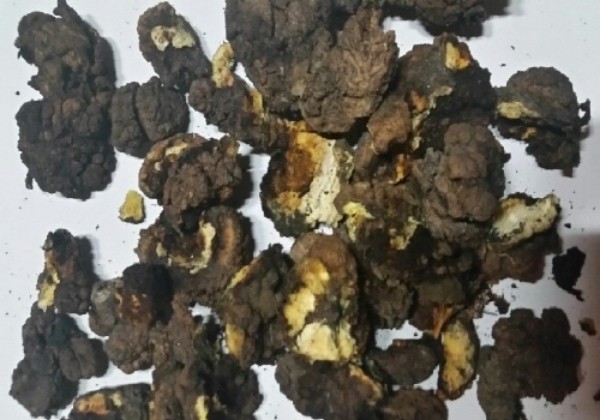
Around the time a consultation about a chaga mushroom extract powder product is wrapping up, the customer asks, "The raw material is definitely Korean-grown, right?" I was caught off guard for a moment, but after explaining in detail about Korean-grown chaga mushrooms, I finished the consultation.
A few years ago, EBS's program called "Extreme Job" introduced people harvesting chaga mushrooms in Korea. These days, it is common for previously broadcast TV programs to be rewatched on YouTube and similar platforms. Also, when you search for chaga mushrooms on YouTube, that video appears at the top of the results. The customer mentioned above also said they had seen chaga mushrooms being harvested in Korea on TV. Naturally, one would think that there are both Korean-grown and foreign chaga mushrooms.
Unfortunately, however, Korean-grown chaga mushrooms barely exist. It is similar to looking for a polar bear in Korea. Even if one were somehow found after great difficulty, harvesting it itself is illegal. The chaga mushroom harvesting scenes on TV were probably filmed in privately owned forests.
The reason chaga mushrooms have difficulty growing in Korea is that chaga mushrooms grow on birch trees. Birch is a tree that mainly grows in cold climate zones at high latitudes. The taiga regions of Siberia, Northern Europe, and Alaska are where birch trees grow.
In our country, which has a temperate climate, they do not even grow well, and they are found only in small quantities in parts of Gangwon Province. Since there are few birch trees in Korea, chaga mushrooms do not grow there either.
The growth characteristics of chaga mushrooms are another reason they are hard to find in Korea. Chaga mushrooms are usually found on about one out of several hundred or several thousand birch trees. Also, while other mushrooms grow in clusters on a single tree, chaga mushrooms grow only one per birch tree.
Even if two chaga mushrooms happen to start growing on the same birch tree, before long only one chaga mushroom survives. This is because growing a single chaga mushroom requires the nutrients of an entire birch tree.
Therefore, to harvest enough chaga mushrooms to use as the raw material for chaga mushroom products, an enormous amount of birch trees and a vast expanse of birch forest are required. Given the reality of our country, where birch trees are scarce and the land area is small, a birch forest of such a scale is an impossible fantasy from the start. A birch forest stretching endlessly even after driving for hours is a landscape only possible in Siberia.
The quality of chaga mushrooms is also an issue. The reason chaga mushrooms store nutrients is that they must survive for decades in a harsh environment. In an environment favorable for growth, they simply use the nutrients for growth rather than storing them.
Therefore, the colder the weather and the harsher the environment, the better the quality of the chaga mushroom. Even in Siberia, chaga mushrooms from the relatively warm southern regions are of comparatively lower quality. Let alone expecting good-quality chaga mushrooms from Korea's climate and environment.
Chaga mushrooms that grow on other trees are also hard to expect quality from. Since there are not many birch trees in our country, chaga mushrooms occasionally grow on other trees such as the Amur cork tree or the Manchurian alder. In the TV program mentioned earlier, there is a scene where chaga mushrooms are harvested, and I remember the chaga mushrooms being harvested from a tree other than a birch tree.
Chaga mushrooms act like a warehouse that absorbs and stores the nutrients of the birch tree. The unique efficacy of chaga mushrooms can be said to originate from the birch tree. Therefore, chaga mushrooms that grow on trees other than birch cannot be expected to have the unique efficacy of chaga mushrooms, and can only be called chaga mushrooms in name.
Korean-grown chaga mushrooms — it sounds plausible, but you are right to think there is no substance behind it.
- Kinam Oh, kinam_oh@hanmail.net