

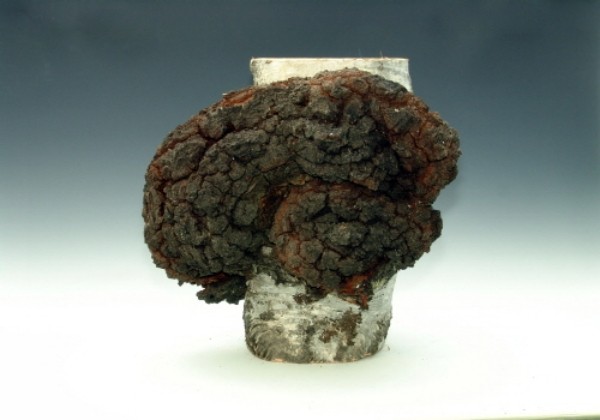
Over the past 20 years, as chaga mushrooms have become widely known and more and more people have been consuming them for their health, misconceptions about chaga mushrooms often arise. The most typical ones are that consuming chaga in its raw form by steeping it is better, or that the skin of the chaga mushroom has many benefits.
In reality, however, chaga extract powder products are far more effective and safer than the raw material, and the skin of the chaga mushroom is a part that must be removed.
Chaga raw material is distributed in the form of pieces or chunks, or powder mechanically ground down, and since it cannot be consumed directly, it is used by steeping it in water for a long time and drinking it.
In this way, only the chaga components that dissolve into the water are consumed, and this is a very small amount compared to the total nutrients contained in the chaga mushroom, making it difficult to drink a large amount in this manner. Therefore, the method of consuming the raw material directly has low nutrient intake efficiency, making it difficult to fully obtain the desired health effects.
On the other hand, chaga extract powder is a product made by extracting the active components of the chaga mushroom through dedicated equipment and then powderizing it, and it is a form that allows 100% utilization of the nutrients of the chaga mushroom. Because it is in powder form, it is easy to adjust the intake amount according to the purpose of consumption, and in particular, it can effectively supply more nutrients to those whose health condition is not good, so satisfaction is high.
The misconception about the skin of the chaga mushroom also needs to be corrected. The outer skin of the chaga mushroom is dead tissue in which life activity has ceased, and it is already in an oxidized state.
Oxidation is a phenomenon in which a substance changes its properties by combining with oxygen or losing hydrogen — the same principle as iron rusting or food spoiling. Oxidized chaga skin is difficult to expect any benefits from, and rather can interfere with the absorption of other active components.
Of course, strong antibacterial components exist in the skin, but this is a double-edged sword. It may not be a big problem for healthy people, but if those with weak immunity consume it, it can cause side effects similar to taking an excessive dose of antibiotics. In some cases, claims are made that it has outstanding benefits based on the antibacterial effect of the skin, but this is unrelated to overall health effects.
For these reasons, when manufacturing products, the skin — which accounts for 20–30% of the total weight of the chaga mushroom — must be completely removed before the material is used. However, some companies do use the material with the skin left on in order to save on raw material costs and to reduce the trouble of removing the skin.
In terms of hygiene as well, extract powder products are far superior. The raw material can be contaminated with bacteria or mold during the distribution and storage processes from after harvest until it is delivered to consumers, and because of the chaga mushroom's properties of being weak to heat, boiling water cannot be used, making hygiene management difficult.
In contrast, extract powder products are produced in a hygienic environment through dedicated equipment, and safety is secured through component and hygiene inspections.
In conclusion, if you want to consume chaga mushrooms in a healthy way, choosing an extract powder product made from chaga raw material with the skin removed is the most effective and safest method. Not being swayed by incorrect information and choosing the right product based on an accurate understanding is the first step in protecting your health.
- Kinam Oh, kinam_oh@hanmail.net