

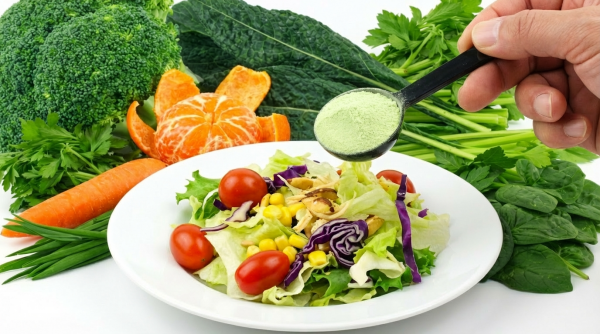
Our company has been selling vegetable powder products for over ten years. Recently, the number of people looking for vegetable powder products to manage their health has grown sharply. Since it is quite difficult to eat fresh vegetables every day amid our busy lives, taking in vegetable nutrients through vegetable powder is a very reasonable alternative. However, as the market has grown, products of wildly varying quality are pouring out. If you choose a product simply because the price is low, or because the advertising model is famous, you may fail to properly take in the nutrients you expected, or you may end up eating unnecessary additives.
So today, I will introduce in great detail the 8 criteria you must check in order to choose a vegetable powder product without fail.
1. Check the types of raw ingredients and the blending ratio.
A vegetable powder product is made by gathering various vegetables and turning them into powder. Therefore, the first priority is to check which vegetables are included and in what proportions. You need to check the actual contents, not just names like 'Contains 20 Vegetables,' 'Mixed Vegetable Powder,' or 'Green Mix.' Surprisingly many products include only a tiny amount of expensive raw ingredients such as kale or broccoli and fill the rest with cheap ingredients. Just like our Ohkinam Chaga Mushroom, check whether a specific blending ratio is written down, such as "Kale 30%, Broccoli 30%, Cabbage 12%...". It is best to avoid products that simply state "kale, spinach, broccoli, etc." or that do not note the blending ratio.
2. Check whether domestically grown (Korean) ingredients are used.
For vegetable powder products, whether domestically grown ingredients are used is a very important measure that determines the freshness and safety of the product. Vegetables begin to lose their nutrients from the moment they are harvested, so the key is to minimize the time from harvest to manufacturing. Foreign ingredients take a long time from harvest to manufacturing and are highly likely to undergo preservation treatment to prevent deterioration during long-distance transport. In contrast, domestic ingredients can be processed immediately after harvest, so the vegetables' natural nutrients and flavor can be preserved in their freshest state.
3. Organic certification is a must, not an option.
Whether the raw ingredients are organic is also a very important selection criterion for vegetable powder products. Vegetable powder is not a product you wash and eat. It is a product you mix into water or a drink and consume right away. If even a trace of pesticide residue remains, it will inevitably be absorbed into our bodies as is. Given these characteristics of vegetable powder, organic certification is a must, not an option. You should choose a product that carries an organic certification mark, not just "pesticide-free" or "eco-friendly" labels. Hygiene certifications such as GMP or HACCP are also good indicators.
4. Check whether it is a 100% vegetable powder product free of excipients or additives.
The next thing to examine is whether the product is 100% vegetable powder, or whether other mixtures are blended in. Be sure to check the 'Ingredient Names and Contents' on the back of the package. If, besides the names of the vegetable ingredients, it lists excipients such as maltodextrin, crystalline cellulose, or silicon dioxide, or artificial flavorings and sweeteners added for taste, it is not pure vegetable powder. When vegetable powder manufacturing technology is lacking, excipients are sometimes used to maintain the product's moisture and improve its storability.
5. Distinguish between vegetable powder and vegetable extract powder.
There is something many people overlook: the difference between 'vegetable powder' and 'vegetable extract powder.' These two are completely different foods. Vegetable powder is made by drying and grinding the whole raw material, so it contains dietary fiber, the core of vegetables, and all the nutrients just as they are. In contrast, vegetable extract powder is a product made by powdering green juice with the dietary fiber removed, or by extracting only specific components. If you want to fully take in the dietary fiber and various micronutrients, which are the biggest reasons we eat vegetables, you must choose a vegetable powder product. Vegetable extract powder only needs to be considered when you need to intensively consume specific functional ingredients.
6. Check the freeze-drying method.
For vegetable powder, it is important to preserve the nutrients and color of the vegetables well, and the drying method best suited to this is freeze-drying. In this method, the vegetables are washed clean, put whole into a dryer, and their moisture is sublimated at minus 35 degrees Celsius or below. It is a drying method that well preserves heat-sensitive vegetable vitamins, enzymes, and chlorophyll, and maintains the vegetables' natural colors. It is best to pass on products that are not freeze-dried or that do not disclose their drying method at all.
7. Examine the color and aroma.
The color and aroma of a vegetable powder product can also serve as criteria for judgment. It is easy to assume that a darker color means richer nutrition, but vegetable powder is different. A color that is too dark or tinged with black most likely means the product was heat-treated, and if the color is too vivid, there is a possibility that pigment was added. A natural vegetable powder maintains a subtle, distinctive color, and it is normal for the color to differ slightly by season or harvest time. It is normal for it to have a natural grassy scent, like dried fresh vegetables; if it smells artificially pleasant or has no smell at all, you should suspect additives.
8. Check the manufacturing date and the expiration date.
No matter how good the raw ingredients are and how excellent the manufacturing process is, the nutrients of natural products inevitably diminish little by little over time. Although its low moisture content makes it incomparable to raw vegetables, it is best to buy a product within 6 months of manufacturing whenever possible. For reference, the shelf life of vegetable powder products is 2 years from the date of manufacture.
Vegetable powder is a valuable tool that replenishes the energy of nature that we find hard to take in during our everyday lives. However, a wrong choice can leave you without the effects you expected, or make you consume unnecessary additives. Please note down the 8-item checklist I shared today and compare it against the detailed page of the product you plan to purchase. You will be able to make a choice without fail. I sincerely support your healthy life.
- Kinam Oh, kinam_oh@hanmail.net