

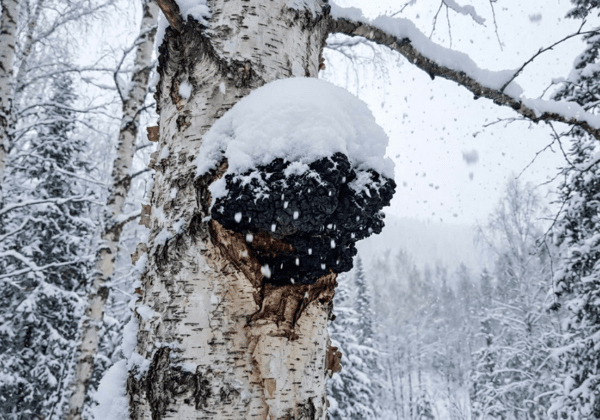
Today I would like to explain the components that make up chaga mushroom. However, there is one problem: chaga mushroom is legally classified as a food, so companies and individuals selling chaga mushroom are prohibited from advertising its efficacy. In other words, there is no problem with introducing the components of chaga mushroom, but I cannot explain what benefits these components may have. It is a frustrating situation, so I ask for your understanding in advance.
What Makes Chaga Mushroom's Components Different
The components of chaga mushroom differ fundamentally in origin and formation process from those of ordinary mushrooms.
Unlike most mushrooms, which grow by decomposing organic matter in dead trees or humus soil, chaga mushroom grows exclusively as a parasite on living birch trees. From the birch tree's perspective, chaga mushroom is a pathogen and an invader that threatens its life, so the tree resists by continuously producing powerful natural chemical protective substances to defend itself. Chaga mushroom withstands the full force of this ferocious host attack while absorbing the tree's lignin and sap, and in the process it concentrates within its own body, over a long period, the self-protective substances that the birch tree releases.
In addition to this unique component-absorption process, the harsh natural environment in which chaga mushroom grows pushes the potency of its active components to the extreme. Chaga mushroom endures roughly twenty years amid Siberia's brutal cold of several tens of degrees below zero, intense ultraviolet radiation, and attacks by countless microorganisms. To survive under this severe stress, chaga mushroom developed its own sophisticated biological defense mechanisms, and as a result it has accumulated a variety of powerful components within its body.
Ultimately, the components of chaga mushroom can be seen as a singular compound completed by the combination of the fierce defensive substances the birch tree created to protect itself and the survival instinct of chaga mushroom itself, which endured twenty years in the harshest of natural environments.
Six Key Components of Chaga Mushroom
To date, more than one hundred major components have been identified in chaga mushroom, but the components that academia has repeatedly focused on are the following six.
1. Beta-Glucan and Polysaccharides
Beta-glucan is a core macromolecular polysaccharide component of mushrooms, including chaga mushroom. This component is being studied in depth primarily in the fields of immunology and immunophysiology. Researchers are conducting studies exploring how beta-glucan binds to the surface receptors of immune-related cells such as macrophages and dendritic cells and what effects it has on intracellular signaling pathways, as well as how it is linked to overall immune-regulation mechanisms.
2. Chromogenic Complex
The collective term "chromogenic complex" refers to the combination of melanin-family pigments, which form chaga mushroom's characteristic deep dark-brown color, and phenolic compounds. This composite component is studied mainly in the fields of biochemistry and food and nutritional science. Russia and other countries with traditions of chaga use have employed it as a quality indicator for gauging the total content of active components in the raw material, while in modern academia research is being conducted to verify its association with antioxidant mechanisms that suppress cell-damage processes and with tissue-protective effects.
3. Betulin and Betulinic Acid
Betulin and betulinic acid are triterpenoid components found in abundance in the bark of the host birch tree, substances that accumulate along with lignin and sap as chaga mushroom absorbs them. This group of components is a major research subject in the fields of natural-product chemistry and oncology. In particular, they are actively studied in cell-level basic research on antitumor mechanisms that observe pathways inducing apoptosis in abnormal cells, inhibition of the cell-division cycle, and selective reactivity compared with normal cells.
4. Triterpenoids Such as Inotodiol, and Sterols
Inotodiol, which is isolated uniquely from chaga mushroom, along with trametenolic acid and ergosterol derivatives, is studied in the fields of medicinal chemistry and molecular biology. Academia is conducting in vitro and in vivo (animal-model) studies to elucidate how these components regulate major intracellular signaling pathways, as well as mechanisms of gene-expression suppression and of the inhibition of inflammatory mediator activity.
5. SOD and Minerals
Chaga mushroom contains SOD (superoxide dismutase) together with minerals such as manganese and zinc, which act as coenzymes at the enzymes' active sites. This is an area receiving considerable attention in the fields of oxidative biology and aging research. Researchers are exploring the role of these substances as exogenous factors that support the body's own antioxidant defense system and the activation of enzyme systems, as well as the combined mechanisms of action by which they mitigate oxidative-stress-induced cell damage.
6. Polyphenols, Flavonoids, and Lignin-Derived Substances
The phenolic compounds, flavonoids, and water-soluble lignin derivatives accumulated in chaga mushroom are dealt with in the fields of plant pathology, environmental toxicology, and metabolism. Regarding these substances, which were formed to counter external environmental stimuli and microbial invasion, researchers are conducting diverse studies on their ability to scavenge harmful reactive oxygen species, their mechanisms for inhibiting the cellular adhesion of microorganisms and viruses, and their effects on the intestinal environment and bile-acid metabolism.
The Safety of Drinking Chaga Mushroom
The safety controversy surrounding chaga mushroom stems largely from two sources. One is the rumor that "it burdens the liver and raises liver enzyme levels," and the other is the warning that "oxalate damages the kidneys." Yet the actual research findings and my own twenty-two years of experience selling chaga mushroom point in a completely different direction.
If chaga mushroom truly burdened the liver, then consuming chaga mushroom should raise AST and ALT, the liver enzyme levels. There have been dozens of studies on this to date, and every one of them concludes that chaga mushroom does not raise liver enzyme levels. I hardly need to mention that I myself, a carrier of hepatitis B, have consumed chaga mushroom for the past twenty years.
The issue of oxalate-related kidney toxicity concerns cases of people who consumed chaga mushroom ground powder, made by mechanically grinding whole chaga mushroom chunks—not a problem with chaga mushroom extract powder. The oxalate content of 1 gram of chaga mushroom extract powder is at most 18 mg per gram, a figure lower than the oxalate in a single spinach leaf, a vegetable known for its high oxalate content. (One spinach leaf weighs about 2.5 g and contains 24.25 mg of oxalate.) The problem applies only to drinking chaga mushroom ground powder that contains abnormally high levels of oxalate.
- Kinam Oh, kinam_oh@hanmail.net