


Freeze-drying is a good technology. However, it is a method that does not suit Chaga powder. For dried vegetables, dried fruits, instant foods, and other cases where the raw material is eaten directly or where preserving the form of the raw material matters, freeze-drying is the right method. Our company's vegetable powder products are also manufactured using the freeze-drying method.
However, Chaga is not a product that is eaten directly. Its nutrients are extracted from hard wood and then consumed. Chaga powder has already gone through extraction and concentration processes, so the form of the raw Chaga material no longer exists. It is a product that does not fit the purpose of freeze-drying at all.
I will now explain what problems arise when Chaga extract powder is freeze-dried.

1. The Fatal Loss of Chaga's Active Compounds
The drying process is the final stage after extraction and concentration, a process that evaporates the moisture in the concentrate to turn it into powder. The quality of the product is already determined through the extraction and concentration processes, and quality cannot be raised through the drying process.
The core of the drying process is not raising the quality of the product, but rather how much the loss of nutrients that occurs during the evaporation of moisture can be minimized. Many of the physiologically active substances (phytochemicals) that Chaga possesses are composed of volatile compounds that are sensitive to heat and environmental changes.
Therefore, the longer the drying time, the greater the evaporation and loss of these volatile substances inevitably becomes. While the spray-drying method (SD) finishes drying in just 15-30 seconds and the low-temperature vacuum-drying method (VD) finishes in 30-60 minutes, the freeze-drying method takes a full 24 hours, up to a maximum of 72 hours.
Because it must continuously suck out the air and moisture inside the drying tank and maintain a strong vacuum state for such a long time, the physical and chemical stress that the Chaga concentrate is subjected to cannot help but be extreme. As a result, the freeze-drying method is the drying method in which Chaga's core volatile nutrients are lost the most.

2. The Risk of Iron Powder in the Grinding Process
Another decisive reason why the freeze-drying method does not suit Chaga extract powder is the possibility of iron powder contamination.
The Chaga extract that has completed the long freeze-drying process loses all its moisture and turns into a very hard, difficult-to-break block of ice. In order to turn this into a fine powder form that consumers can ingest, a separate grinding process that crushes it with strong force must necessarily follow.
The problem is that in this grinding process, the hard Chaga solids and the metal blades of the grinder rub strongly against each other, generating fine iron powder that structurally carries the risk of being mixed into the product. Freeze-drying is always a method that carries the possibility of iron powder contamination.
On the other hand, the spray-drying method, which atomizes the liquid into fine droplets and dries it in an instant, requires no separate grinding process at all, so the concern of iron powder generation is fundamentally blocked.
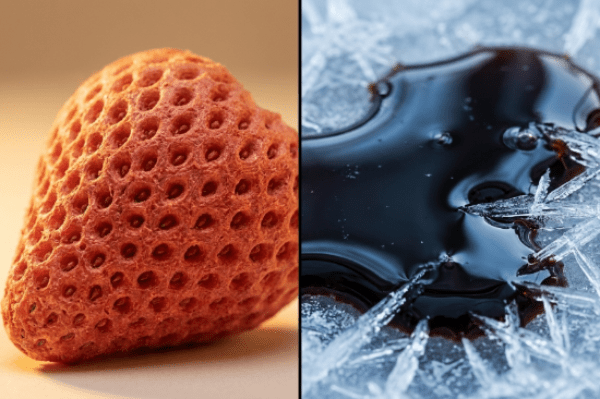
3. Chaga Powder That Does Not Suit Freeze-Drying
The freeze-drying method was originally a technique developed to dry vegetables or fruits that contain a large amount of moisture while preserving their original appearance and color before drying as closely as possible. If what we consume were the raw Chaga block itself, the freeze-drying method, which preserves Chaga's outward appearance, could be an excellent option.
However, Chaga extract powder is not made by directly drying the raw material. It is drying a concentrate (gustoi), a sticky liquid state with 35% solids, whose Chaga's inherent form has already completely disappeared through the extraction and concentration processes.
There is no technical justification whatsoever for applying the freeze-drying method, whose purpose is form preservation, to the process of turning a liquid concentrate—for which no form or color that ought to be preserved exists in the first place—into powder.
A Matter of Marketing, Not a Technical Matter
In fact, in Siberia, Russia—the home of Chaga extract powder production—there were for a long time no companies producing Chaga extract powder using the freeze-drying method.
It is not because they lacked technical capability. It is because the conclusion that the freeze-drying method does not suit the characteristics of Chaga extract powder and is rather an inefficient method that lowers quality while excessively consuming only production cost and time had already been settled among local experts long ago.
The fact that some Russian companies recently began producing Chaga extract powder using the freeze-drying method is, on the contrary, due to the special requests of Korean sellers, and is not the result of technological development but a change brought about by market marketing.
In order to truly maximize Chaga's efficacy, one should not cling to the flashy name of a drying method, but should focus on the principle of selecting good raw materials, extracting at low temperature, safely concentrating them in a vacuum state, and then shortening the drying time as much as possible to fully protect the nutrients as nature intended.
In conclusion, the freeze-drying method is a drying method that harms the essential value of Chaga extract powder and does not suit Chaga at all.
- Kinam Oh, kinam_oh@hanmail.net