

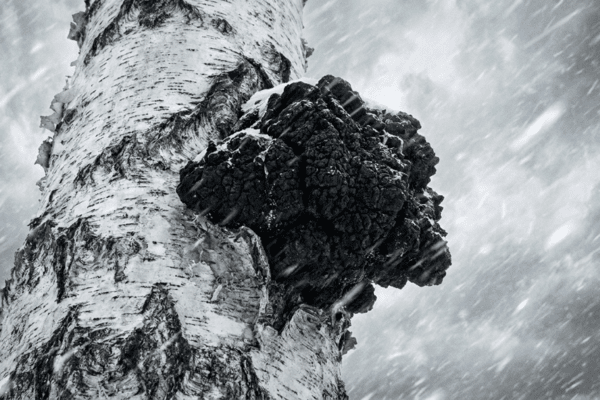
Chaga is a wild mushroom that grows on its own for about twenty years in Siberia. When I tell people this, they often ask whether chaga is difficult to grow or farm in Korea. To give the conclusion first: it is difficult, and the quality is bound to be inferior, so it is a pointless undertaking. Let me explain.
First, let us consider domestic cultivation of chaga.
To cultivate chaga, you need birch trees. You would have to plant chaga's spores on birch and grow them from there. Chaga's efficacy originates in the birch. Chaga growing on trees other than birch loses chaga's inherent efficacy — it is chaga in name only.
However, birch is not a tree commonly seen in Korea. It grows mainly in the forests of the cold boreal taiga, which is colder than Korea. No matter how many birches you plant for chaga cultivation, the climate does not suit them, so not many of them grow properly.
Even if you manage to grow birch, having chaga actually attach itself to the tree and grow is not easy. Even in the birch forests of Siberia, chaga's home ground, only about one tree in hundreds or thousands produces it. In Korea, where the climate does not suit it, that rate would be far lower.
And even if chaga does manage to grow on birch, it takes far too long to reach a commercially viable size. In Siberia it usually needs about twenty years; in hotter Korea it would grow somewhat faster. Even so, at least about ten years would be required.
The problem is that the faster it grows, the worse chaga's quality becomes. Chaga's quality refers to the nutrients it holds, and those are prepared in order to cope with extreme conditions. When the environment is good and growth is fast, chaga has no need to store nutrients in its body.
As such, both growing birch and growing chaga are difficult tasks in Korea, where the land is small and the climate does not suit them. Environmentally and economically, domestic cultivation of chaga is an impossibility.
Now let us look at chaga farming.
To begin with the conclusion: chaga farming is possible. However, it takes far too long to grow, and, decisively, chaga's quality falls far too much.
Decades ago in Russia, the government researched chaga farming using dead wood or cultured material. The project succeeded in growing chaga, but its nutrients and efficacy were so inferior to wild chaga that in the end they gave up on farming it.
A certain well-known Korean company also once researched chaga farming. Using chaga's components as a raw material for medicines or health supplements requires uniform quality, and wild chaga's quality varied far too much from batch to batch. In the end, however, the efficacy was so far below that of wild chaga that the company withdrew from the business.
Chaga's efficacy is created in the process of accumulating nutrients in order to survive a harsh environment. In a farming environment built for growth, chaga has no need to store nutrients.
For a mushroom that grows in a few days or a few months, there is little difference in nutrients or efficacy between the wild and the farmed. But for a mushroom like chaga, which grows over decades while accumulating nutrients in its body little by little, the difference is that of heaven and earth.
That is the answer to the question about domestic cultivation and farming of chaga. I hope it helps your understanding of chaga.
- Kinam Oh, kinam_oh@hanmail.net