


Russian Black Tea Culture and an Alternative for Ordinary People
The place that tea, especially black tea, occupies in the lives of Russian people is far greater than we commonly imagine. For Russians, black tea is a daily habit and cultural practice, much like how people in Korea reach for coffee several times a day. When visiting a Russian household, the very first thing offered to a guest is a warm cup of black tea. This goes beyond simple hospitality; it is also connected to the wisdom of survival—warming the body amid harsh cold.
However, hundreds of years ago, obtaining black tea in Siberia, a vast and barren region, was by no means an easy task. Because tea could not be cultivated there due to the region's characteristics, it had to be brought in from elsewhere, and since the distribution routes were arduous, its price was also far too high for ordinary people to afford. While wealthy aristocrats or the upper class might have managed, for ordinary Siberian farmers and common people, black tea was closer to a luxury item.
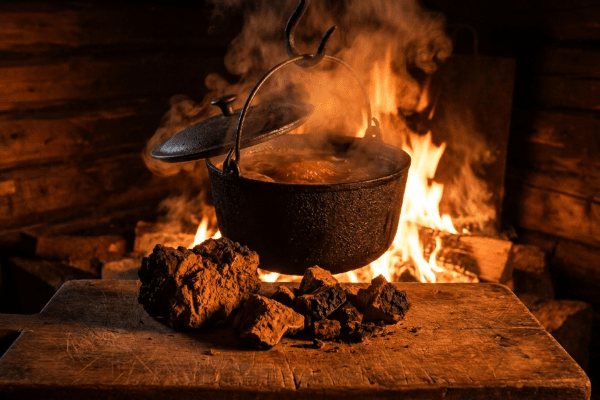
In this situation, the alternative that Siberians discovered was chaga mushroom. They harvested chaga mushroom chunks from birch trees, cut them into small pieces or finely ground them into powder, and then steeped and drank it like tea. As an everyday beverage to replace expensive black tea, chaga mushroom naturally became part of the daily lives of ordinary Siberian people.
The Safety Implied by Drinking It as Tea
Here there is an important point we should pay attention to: the fact that chaga mushroom was consumed in the form of "tea." Tea is, by its very nature, a beverage that can be drunk every day, even several times a day. On some days one might drink only a single cup, while on other days one might drink two, three, or more cups. Being able to consume something so freely and continuously presupposes that the substance is not harmful to the body. If it had been a substance that placed even the slightest burden on the body or contained toxicity, a culture of drinking it daily as tea over hundreds of years could not have formed.
For many years, Siberians drank chaga mushroom this way, like water or tea, without any suspicion. And an interesting fact is that the results of closely observing the local residents who had consumed chaga mushroom as an everyday beverage in this way have been widely passed down. It was confirmed that these regional populations suffered relatively less from the various diseases that so greatly trouble modern people, and this observation became the starting point for full-scale scientific and medical research into chaga mushroom. Long-standing folk experience came first, followed by the process of academically verifying the validity of that experience.
This tradition continues even today. If you visit traditional markets or pharmacies in Russia, you can still easily find chaga mushroom products meant to be steeped and drunk as tea. It continues to maintain its status as an everyday beverage validated over a long period of time.

A Changed Perception After Entering Korea
However, as chaga mushroom, which had been safely consumed as tea in this way, was introduced to Korea, it took on a somewhat different character. Whereas in Siberia it was an everyday beverage consumed by healthy and unhealthy people alike without distinction, in Korea it came to be sought mainly by those struggling with health issues. As this happened, chaga mushroom at some point came to be perceived not as an ordinary food but as something like a special medicine with particular effects, and in that process, concerns and questions about side effects naturally began to be raised.
Of course, these concerns are not entirely without basis. Even the safest black tea could place a strain on the body if one drank dozens of cups a day. This is common-sense reasoning that could equally apply to chaga mushroom. What matters, however, is the question of whether chaga mushroom is safe within a normal range of consumption.

The Scientifically Verified Safety of Chaga Mushroom
Russia has already provided a systematic answer to this question. To confirm the safety of chaga mushroom, Russia conducted a long-term observational study spanning over ten years, involving several hundred patients. Only after carefully monitoring their progress over this extended period and confirming that there were no problems did the Russian government begin recommending chaga mushroom consumption to the entire population.
What is striking is that this was not simply reliance on folklore or a handful of individual cases, but rather a careful and systematic verification process conducted over a long period with a large number of participants. Looking back at this history helps greatly in understanding why chaga mushroom was able to comfortably settle into the daily lives of Siberians for so long, and how this could also be scientifically supported.

A Precious Gift from Nature
Ultimately, the very fact that chaga mushroom has been drunk as tea in Siberia for hundreds of years can be said to be the oldest and most certain evidence of its safety. This tradition, which began from the modest wisdom of ordinary people who could not afford expensive black tea, has continued to the present day after undergoing scientific verification over time. Chaga mushroom can be called a precious gift from nature whose safety has been recognized through many years and various forms of verification.
- Kinam Oh, kinam_oh@hanmail.net